
Micro-Perforated Metal Overview
Micro-perforated metal is sheet metal produced with very small, closely controlled openings compared with conventional perforated metal.
The small hole size allows the sheet to provide controlled airflow, sound transmission, screening or filtration while retaining a relatively continuous metal surface.
Micro perforated metal sheets can be customized according to hole diameter, pitch, arrangement, open area, material thickness and finished dimensions.
Micro-Perforated Metal Sizes and Specifications
For small hole perforated sheet metal, hole diameter, material thickness and pitch must be considered together because manufacturing feasibility becomes more important as the perforations become smaller.
| Specification | Available Options | Selection Notes |
|---|---|---|
| Material | Stainless steel, aluminum, carbon steel, galvanized steel | Select according to corrosion resistance, weight and environment |
| Sheet Thickness | According to hole size and project requirements | Small holes may limit the suitable thickness range |
| Hole Diameter | Micro / small precision openings | Confirm actual diameter rather than specifying “micro” only |
| Hole Pitch | Custom center-to-center spacing | Controls perforation density and open area |
| Hole Arrangement | Straight, staggered or custom layout | Influences appearance and open-area distribution |
| Open Area | Customized percentage | Important for airflow, acoustics and screening |
| Sheet Size | Standard or custom finished dimensions | Production limits depend on perforation specification |
| Perforation Layout | Full, partial or custom areas | Solid zones can be retained for forming and mounting |
| Solid Border | Optional perimeter or local zones | Useful for fixing, bending and assembly |
| Surface Finish | Mill finish, polished, painted, powder-coated or other specified finish | Select according to material and final use |
| Fabrication | Cutting, bending, forming and framing | Available subject to the perforation specification |
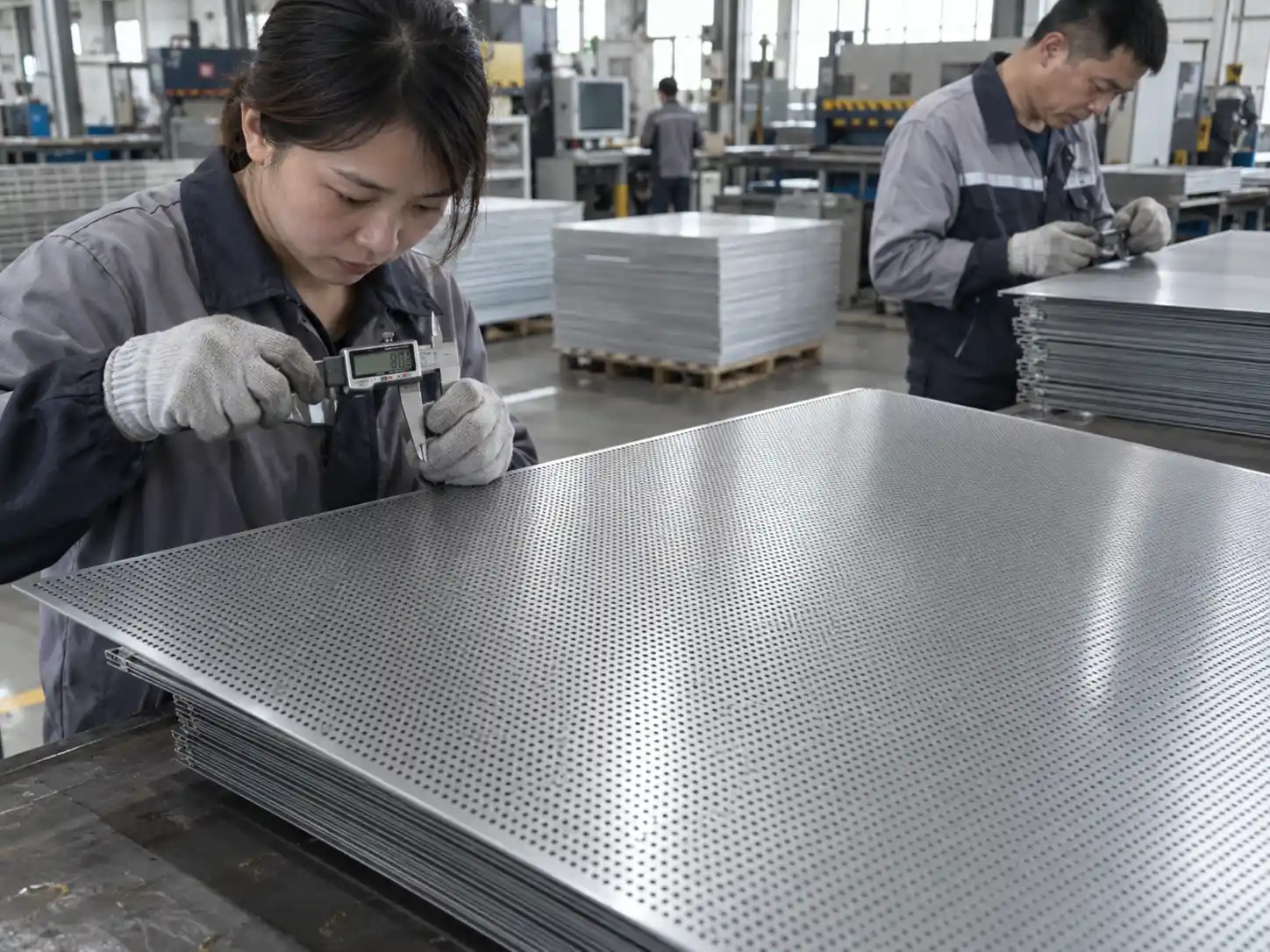
| Tolerance | According to hole diameter and sheet requirements | Critical tolerances should be confirmed before production |
For very small perforations, send the drawing or required hole specification so manufacturability can be checked before quotation.
How to Select Micro-Perforated Metal
Micro-perforated sheets should be selected according to the function of the openings rather than hole size alone.
Hole Diameter
Smaller openings provide finer screening and a more visually continuous surface, but they also affect manufacturing feasibility and airflow.
Hole Pitch
Pitch determines the spacing between holes and has a direct influence on perforation density and open area.
Open Area
The required open area should be specified when airflow, acoustic transmission or pressure drop is important.
Sheet Thickness
Hole diameter and material thickness need to be reviewed together. A very small hole cannot necessarily be produced in every sheet thickness.
Micro-Perforated Metal Materials
Material details remain on your separate Materials pages; this section only introduces the available choices and builds internal links.
Stainless Steel Perforated Metal
Stainless steel provides excellent corrosion resistance and are suitable for demanding environments.
Aluminum Perforated Metal
Aluminum offers lightweight construction and natural corrosion resistance.
Carbon Steel Perforated Metal
Carbon steel provides strength and cost efficiency for general industrial fabrication.
Galvanized Perforated Metal
Galvanized provides additional corrosion protection for outdoor and exposed applications.
Micro-Perforated Metal Applications
Perforated Metal Ceilings & Acoustic Panels
Perforated Metal Filtration & Screening
Industrial Screening & Sieving
Metal Mesh Grilles, Speaker & Radiator Covers
Custom Micro-Perforated Metal Fabrication
Because of the small perforations, secondary fabrication should be considered together with the perforation layout.
Cutting & Sizing
Sheets can be cut into finished panels and components while maintaining required solid border areas.
Bending & Forming
Bend locations can be positioned in non-perforated or suitable areas to reduce distortion around small holes.
Borders & Mounting
Solid zones can be retained for mounting holes, fixing points, frames and formed edges.
Surface Finishing
Finishes can be applied according to the material and required appearance, subject to the small-hole specification.
How to Order Micro-Perforated Metal
Material
Specify stainless steel, aluminum, carbon steel or galvanized steel.
Sheet Thickness
Provide the required base material thickness.
Hole Pitch & Pattern
Specify center-to-center spacing and straight, staggered or other required arrangement.
Open Area
Provide the required open-area percentage where airflow or acoustic performance is important.
Sheet Size & Quantity
Provide finished width, length and required quantity.
Finish & Fabrication
Specify solid borders, bending, mounting details and required surface treatment.
For micro perforations, CAD/PDF drawings or a complete specification are strongly recommended before quotation.
Micro-Perforated vs. Standard Perforated Metal
Micro-perforated metal and conventional perforated metal use the same basic principle, but the opening scale changes their typical selection criteria.
| Comparison | Micro-Perforated Metal | Standard Perforated Metal |
|---|---|---|
| Hole Size | Very small precision openings | Wider range of conventional holes |
| Main Selection Factors | Hole diameter, pitch, open area and thickness relationship | Hole pattern, open area and sheet size |
| Visual Surface | More continuous / fine appearance | More visibly open pattern |
| Airflow | More controlled and potentially more restrictive | Generally easier to achieve higher airflow |
| Screening | Suitable for finer screening requirements | Suitable for general screening |
| Acoustic Use | Often used as facing in engineered acoustic systems | Used in conventional perforated acoustic panels |
| Manufacturing | More sensitive to tooling and thickness | Broader manufacturing range |
Choose Micro-Perforated Metal when very small controlled openings are a functional requirement.
Choose standard Perforated Metal Sheet when larger conventional openings can meet the project requirements.
Case Study : Micro-Perforated Acoustic Facing Panels for a Lecture Hall
Project Requirement
An interior acoustic-system supplier required micro-perforated metal facing panels for a university lecture hall.
The visible surface needed to appear clean and relatively uniform while allowing sound to pass through the metal facing into the acoustic material installed behind it.
Multiple panel dimensions were required, and the perforation appearance had to remain consistent across adjacent ceiling and wall sections.
Manufacturing Solution
Micro-perforated aluminum sheet was selected to reduce finished panel weight and support the required architectural finish.
The micro-hole diameter and pitch were produced according to the customer’s acoustic-system specification rather than selecting the perforation by appearance alone.
Solid perimeter areas were retained for edge forming and installation. Panels were cut to finished dimensions and formed according to the approved drawings.
The finished parts were powder-coated after fabrication, with the coating process reviewed to avoid unnecessarily obstructing the small perforations.
Inspection & Packaging
Panel dimensions, perforation consistency, border widths, formed edges and surface appearance were checked before shipment.
Finished panels were identified by installation position and packed with protective separators to reduce scratching.
Important: The acoustic performance of the completed system depends on the perforated facing together with the backing material, cavity depth and overall acoustic design—not on the metal sheet alone.
Micro-Perforated Metal FAQs
Micro-perforated metal is sheet metal produced with very small precision openings for applications requiring fine airflow, screening, acoustic transmission or a visually continuous surface.
The terms can overlap, but “micro-perforated” generally emphasizes very small controlled openings. The actual hole diameter should always be specified for manufacturing.
The feasible minimum hole size depends on material, thickness, sheet dimensions, tooling and production method. Send your specification for confirmation.
Common options include stainless steel, aluminum, carbon steel and galvanized steel.
Open area influences airflow, sound transmission, screening performance and the amount of solid material remaining in the sheet.
Yes, they can be used as a facing component in acoustic systems, but final acoustic performance depends on the complete panel construction and backing system.
Yes. Non-perforated areas can be retained for folding, mounting, fixing points or panel joints.
Yes, depending on material, thickness and perforation layout. Bend locations should be reviewed before production.
Related Perforated Metal Products
Explore other perforated metal products with different sheet forms, screening functions and hole patterns for industrial, architectural and custom fabrication requirements.
Perforated Metal Sheet
Perforated metal sheets with customizable materials, thicknesses, hole sizes and open areas for further fabrication and general applications.
Perforated Metal Panels
Finished perforated panels for architectural walls, facades, ceilings and project installations.
Perforated Metal Screen
Perforated screen panels for privacy, ventilation, security and separation applications.
Hexagonal Perforated Metal
Six-sided perforations for geometric appearance, ventilation and screening.
Round Hole Perforated Metal
Circular perforations for ventilation, filtration and general screening.
Slotted Perforated Metal
Elongated openings for directional airflow, drainage and separation.
Corrugated Perforated Metal Panels
Profiled perforated panels providing increased rigidity and a three-dimensional surface.
Square Perforated Metal
Square openings providing a clean geometric pattern for architectural and industrial applications.