Standard Expanded Metal Overview
Standard expanded metal is supplied in its original form after the slitting and expanding process, retaining the characteristic raised strand profile.
It combines rigidity, open area and material efficiency for general fabrication, guards, fencing, panels and architectural components.
Standard Expanded Metal Sizes and Specifications
Standard expanded metal should be specified by its material, mesh dimensions, thickness, sheet size and orientation.
| Specification | Available Options | Ordering Notes |
|---|---|---|
| Material | Carbon steel, stainless steel, aluminum or galvanized steel | Select according to strength, weight and corrosion requirements |
| SWD & LWD | According to the required mesh pattern | Defines the short and long directions of the expanded pattern |
| Strand Width | Selected according to mesh and strength requirements | Influences rigidity, weight and open area |
| Base Thickness | According to material and required strength | Refers to the original sheet thickness before expansion |
| Sheet Size | Standard format or custom width and length | Availability depends on material, thickness and mesh pattern |
| Mesh Direction | SWD or LWD aligned with sheet length | Should be shown on drawings for repeat production |
| Edge Condition | Random cut, trimmed, framed or U-edged | Select according to further processing and installation |
| Surface Finish | Mill finish, galvanized, painted, etc. | Availability depends on selected material |
Available specifications depend on the selected lath type, material and manufacturing method. Send your drawing or required specification for confirmation.
How to Select Standard Expanded Metal
The correct specification depends on the required opening, rigidity, sheet size and final use.
Mesh Opening
Larger openings provide more airflow and visibility, while smaller openings create a denser structure for closer screening and protection.
Thickness and Strand Width
Base thickness and strand width influence the rigidity and weight of the finished expanded metal. Both should be selected together with the mesh opening.
Sheet Size and Direction
Specify the finished width and length together with SWD or LWD orientation to maintain consistent appearance and fabrication across repeat panels.
Material and Finish
Choose the material and finish according to corrosion exposure, appearance, weight and operating environment.
Custom Standard Expanded Metal Fabrication
Standard expanded metal can be supplied as raw material or processed into finished panels and OEM components.
Cutting and Sizing
Sheets can be cut into panels, strips and shaped parts while maintaining the required mesh direction and finished dimensions.
Bending and Forming
Standard expanded metal can be formed into guards, covers, trays and other fabricated components according to approved drawings.
Welding and Framing
Panels can be welded to frames, brackets and reinforcement sections for improved rigidity and easier installation.
Surface Finishing
Galvanizing, painting, powder coating and anodizing can be selected according to the material and service environment.
Expanded Metal Available Materials
Expanded metal is available in different metals to meet requirements for strength, weight, corrosion resistance and appearance.
Stainless Steel Expanded Metal
Stainless steel provides corrosion resistance for food processing, chemical, marine and demanding industrial environments.
Aluminum Expanded Metal
Aluminum is lightweight and corrosion-resistant for transportation, ventilation, architectural and decorative components.
Carbon Steel Expanded Metal
Carbon steel provides strength and cost efficiency for industrial guards, covers, racks and fabricated parts.
Galvanized Expanded Metal
Galvanized steel has a zinc-protected surface for outdoor, construction, security and general industrial projects.
Standard Expanded Metal Applications
Standard expanded metal is commonly used where an open structure, rigidity and visibility are required.
Machine Guards and Safety Barriers
Expanded Metal Security Fencing
Expanded Metal Railings and Infill Panels
Expanded Metal Facades and Cladding
Why Choose Us for Standard Expanded Metal?
We focus on specification consistency for repeat sheet, panel and OEM orders.
Consistent Mesh Geometry
SWD, LWD and strand formation are controlled according to the approved specification.
Stable Sheet Orientation
Mesh direction can be maintained across repeat panels for consistent appearance and fabrication.
Custom Panel Sizes
Full sheets can be cut to project-specific dimensions to reduce further processing and material waste.
Repeat Order Control
Approved drawings and specifications can be used as references for future production batches.
How to Order Standard Expanded Metal
Provide the following information so we can confirm the specification and prepare an accurate quotation.
Material
Specify carbon steel, stainless steel, aluminum, galvanized steel or another required material.
Mesh Specification
Provide the SWD, LWD, strand width or a reference mesh designation.
Thickness
Confirm the required base metal thickness.
Sheet Dimensions
Provide the finished width, length, quantity and required mesh orientation.
Edge and Finish
Specify the edge condition and any galvanizing, painting, powder coating or anodizing.
Fabrication Requirements
Send drawings for cutting, bending, welding, framing or other secondary processing.
Standard vs. Flattened Expanded Metal
Standard and flattened expanded metal originate from the same expanding process but have different finished profiles.
| Comparison | Standard Expanded Metal | Flattened Expanded Metal |
|---|---|---|
| Surface | Raised and textured | Smooth and level |
| Processing | Supplied after expansion | Rolled after expansion |
| Finished Profile | Thicker | Lower and flatter |
| Rigidity | Generally higher for comparable patterns | Lower profile and smoother handling |
| Typical Use | Guards, fencing, panels and general fabrication | Screens, inserts and decorative panels |
Choose Standard Expanded Metal when the original expanded profile and rigidity are preferred.
Choose Flattened Expanded Metal when a smoother and lower-profile surface is required.
Case Study : Standard Expanded Metal for Industrial Equipment Enclosures
An industrial equipment manufacturer required expanded metal panels for ventilated equipment enclosures. The panels needed to protect internal components while allowing continuous airflow and maintaining sufficient rigidity without adding unnecessary weight.
Project Requirements
The customer required consistent mesh openings, controlled panel dimensions and the same mesh orientation across multiple enclosure sizes. The material also needed enough rigidity to maintain its shape during fabrication and installation.
Product Solution
Standard carbon steel expanded metal was selected because its original raised profile provided greater rigidity than a flattened mesh while maintaining an open structure for ventilation.
The sheets were cut into different panel sizes according to the customer’s drawings, with the LWD direction kept consistent across the production batch. Selected panels were also bent and formed for direct integration into the equipment housings.
A protective powder-coated finish was applied after fabrication for improved corrosion resistance and a uniform industrial appearance.
Inspection and Packaging
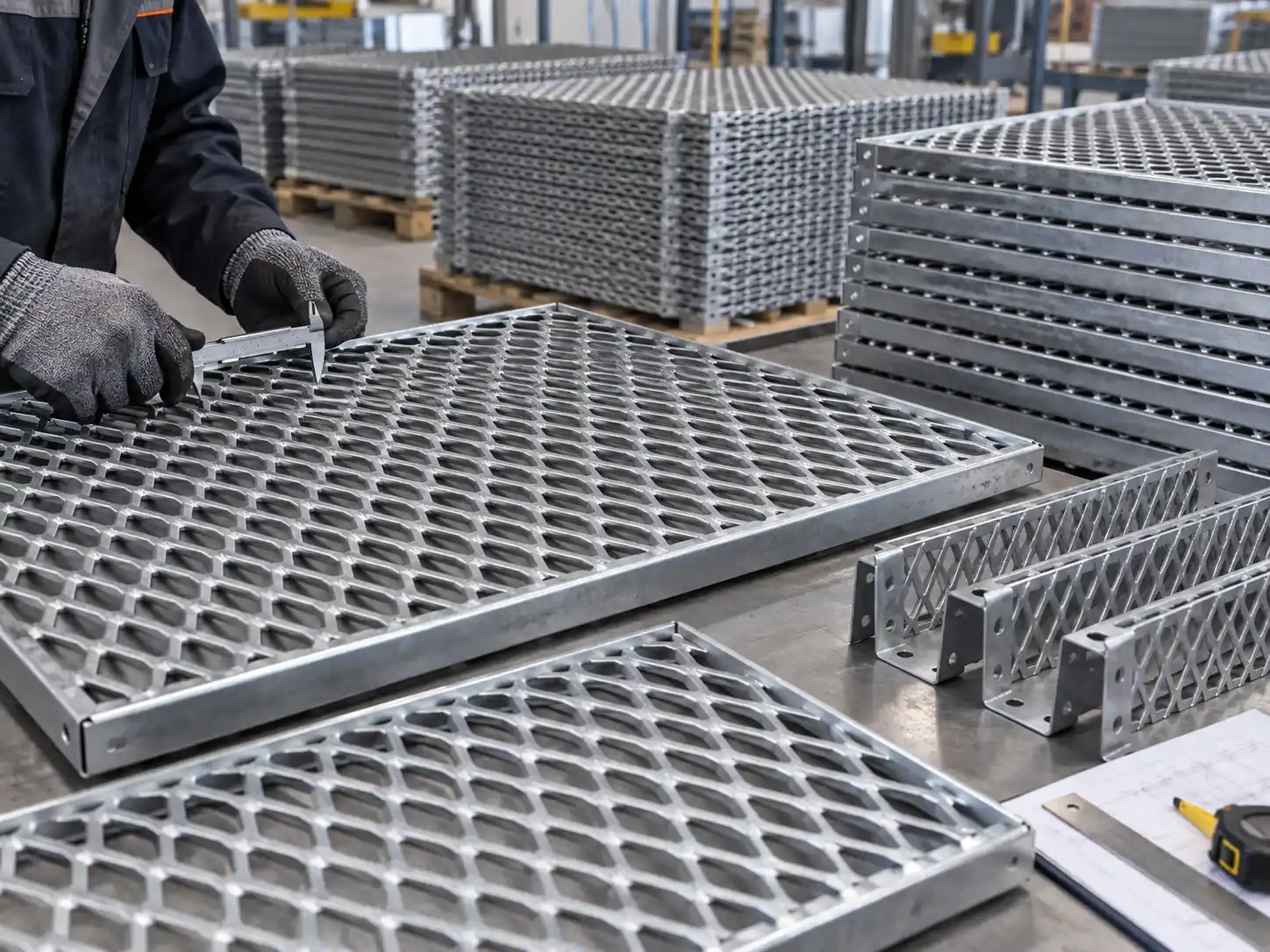
Finished panels were checked for overall dimensions, mesh consistency, orientation, edge condition and coating appearance.
Panels were separated and securely packed to reduce bending, rubbing and deformation during transportation.
This solution is suitable for equipment enclosures, ventilation covers and general industrial components requiring a combination of rigidity, airflow and economical material use.
Standard Expanded Metal FAQs
Standard expanded metal is produced by slitting and stretching a solid metal sheet and is supplied without the additional flattening process.
The terms are closely related because standard expanded metal retains the raised profile created during expansion. This page focuses on standard specifications and product supply, while the Raised Expanded Metal page focuses on raised-surface characteristics and performance.
Available sizes depend on the material, thickness and mesh pattern. Full sheets and custom cut panels can be supplied according to project requirements.
A typical specification includes material, SWD, LWD, strand width, base thickness, sheet dimensions, mesh direction and finish.
Yes. Sheets can be cut into custom panels, strips and shaped parts according to drawings or finished dimensions.
Common materials include carbon steel, galvanized steel, stainless steel and aluminum.
Yes. Standard expanded metal can be cut, bent, welded and framed for guards, fencing, railings and custom components.
Related Expanded Metal Products
Explore other expanded metal products based on the required mesh structure, surface profile, strength and final application.
Expanded Metal Sheet
Full-size, cut-to-size and fabricated expanded metal sheets for industrial and OEM production.
Expanded Metal Mesh
Expanded metal selected according to opening dimensions, strand size and open area.
Expanded Metal Screen
Framed and fabricated panels for protection, ventilation and architectural screening.
Expanded Metal Lath
Expanded metal products for plaster, stucco and construction reinforcement systems.
Raised Expanded Metal
Raised mesh with a textured profile, increased rigidity and improved surface grip.
Flattened Expanded Metal
Rolled expanded metal with a smoother, thinner and more level surface.
Expanded Metal Grating
Expanded grating for industrial flooring, platforms, walkways and stair treads.
Heavy-Duty Expanded Metal
Thicker expanded metal for machinery guards, barriers and demanding industrial environments.